A bill calendar template should show more than due dates. It should show when each payment needs to start and which payday or existing balance will cover it.
A month can look affordable in total and still leave one week short. That is a timing problem. Putting bills, paydays and payment dates in the same view lets you see the problem while there is still time to change the plan.
In this guide, you will build a bill calendar in Google Sheets, assign each bill to a funding source and flag any window where the timing does not work yet. No worries if a utility amount changes from month to month. Start with a reasonable estimate and update it when the statement arrives.
This post is all about building a bill calendar template that maps every bill to the money intended to pay it.
A practical bill calendar template starts with three dates
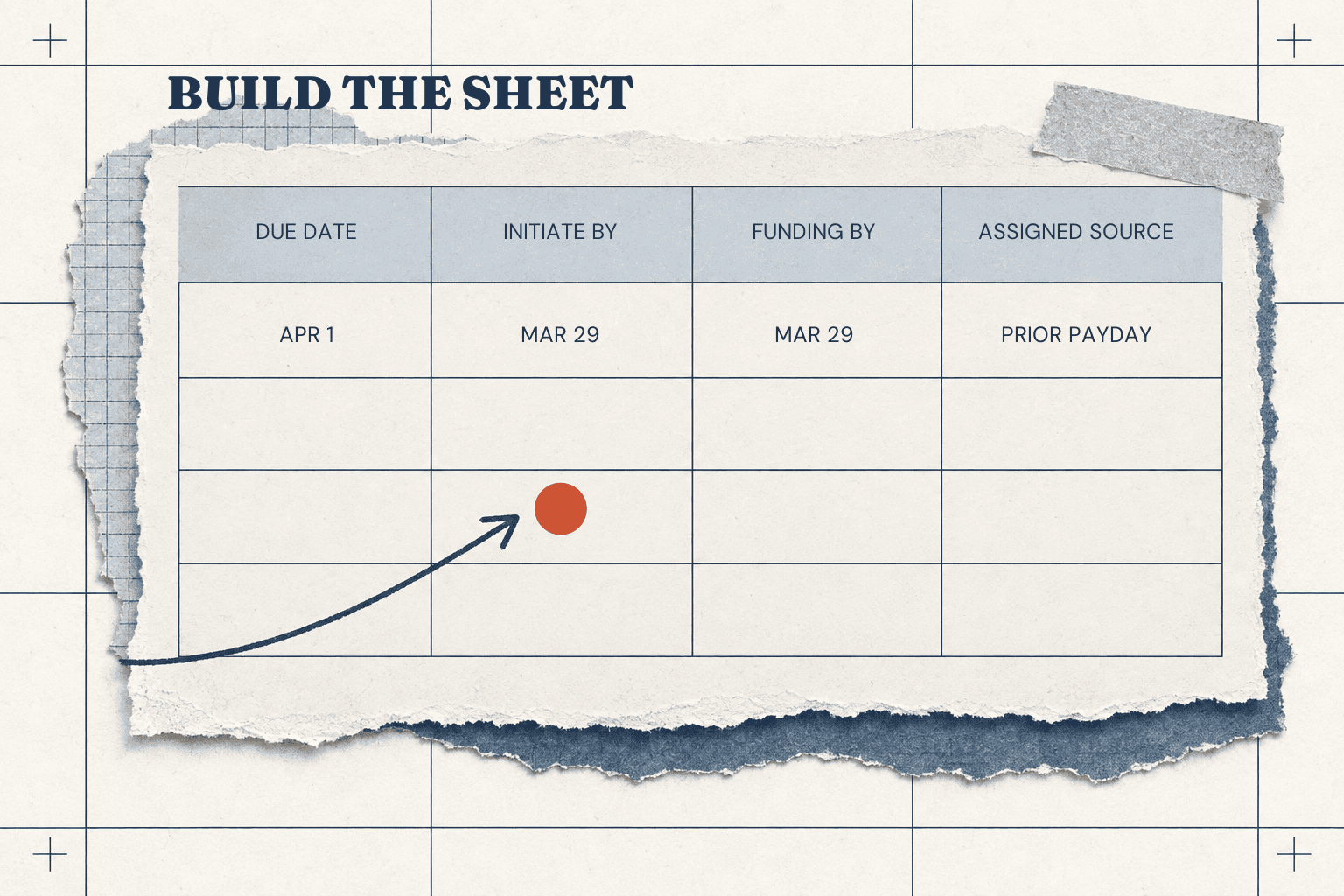
Most bill lists record one date: the due date. A useful bill calendar records three:
- Due date: when the company expects the payment.
- Initiate-by date: when you plan to submit, schedule or mail it.
- Funding-needed date: when the money must already be available in the paying account.
Then add one more piece of information: the payday or existing balance assigned to cover the bill.
That last column is what turns a list into a plan. If rent is due April 1, writing “April 1 paycheck” beside it may reveal a problem. The payment could need to be scheduled before that paycheck arrives. The calendar should say so plainly.
The Consumer Financial Protection Bureau describes a bill calendar as a tool for tracking what you owe and when it is due, and recommends keeping it somewhere you can check weekly. Its printable calendar also suggests marking online payments two days before the due date and mailed payments seven days before it. Those are useful starting points, but your biller’s rules and processing times still control. (CFPB bill-calendar guide; CFPB bill calendar)
Gather one month of bills and recurring charges
Start with one real month. Pull the statements, account pages or notices for anything that will take money from the household:
- rent or mortgage;
- electricity, gas, water and trash;
- internet, phone and subscriptions;
- insurance premiums;
- car payments and other installment loans;
- credit card minimums;
- student loans;
- childcare, memberships and recurring services;
- automatic withdrawals that are easy to forget; and
- annual or semiannual costs that happen during this particular month.
Use the amount on the current statement when you have it. For a variable bill that has not arrived, enter a reasonable estimate and label it as an estimate. You can replace it later.
Do not put full account numbers, login information or other sensitive details in the calendar. A short nickname such as Electric, Visa household or Car insurance is enough. The CFPB’s own calendar cautions against including names, account numbers or other sensitive information when a worksheet may be shared. (CFPB bill calendar)
Build the bill list in Google Sheets
Open a blank Sheet and name the tab for the month, such as April 2026 Bill Calendar.
Create these columns:
| Column | What to enter |
|---|---|
| Bill | A short name such as Rent or Electric |
| Payee / account nickname | A non-sensitive label, never a full account number |
| Due date | The date shown on the bill |
| Amount | The amount due or a labeled estimate |
| Payment method | Online, mail, autopay, bank bill pay or in person |
| Initiate-by date | The date you plan to submit or schedule payment |
| Funding needed by | The date the money must be available |
| Assigned payday / source | The deposit or prior-period balance covering the bill |
| Paid | A check mark or the date paid |
| Notes | A short exception or reminder without sensitive information |
Keep the real due date. Do not move it to payday on the sheet simply because that looks cleaner. The mismatch is information you need.
If you prefer paper, the same columns can become a bill pay schedule template in a notebook or on a printed monthly calendar. Google Sheets is useful because you can sort by date, update estimates and duplicate the tab for next month.
Add paydays and dependable income dates
Add a small income table on the same tab or create a second tab.
| Column | What to enter |
|---|---|
| Income source | Job, benefit or other dependable deposit |
| Arrival date | The date the money normally becomes available |
| Net amount | The amount deposited after deductions |
| Confidence | Confirmed or a conservative estimate |
| Notes | Holiday shifts, processing lag or another timing detail |
If income varies, use an amount you feel confident will arrive rather than the best recent month. The CFPB’s due-date worksheet gives similar guidance for variable inflows: estimate an amount you can confidently expect, then compare the week it arrives with the bills due in that week. (CFPB due-date worksheet)
This is also where a bill calendar and a zero-based budget separate into two different jobs. The calendar shows when money needs to move. A zero-based plan assigns the money already available to bills, groceries, transportation, savings and other priorities. YNAB describes this approach as giving jobs to dollars currently on hand rather than planning with income that has not arrived. (YNAB method guide; YNAB zero-based budgeting guide)
You do not need to use YNAB to apply the distinction. The practical question is simple: what does the money available now need to cover before more money arrives?
Mark the payment-initiation date
A due date is not always the day to begin paying.
The CFPB bill calendar marks online payments two days before the due date and mailed payments seven days before it. Run Your Household uses about three days early as a practical household starting point for many online payments, but that is not a rule and it will not fit every account. Check the statement, payment portal and biller’s cutoff rules.
Credit cards are one reason to be precise. The CFPB says card issuers generally cannot treat a payment as late when it is received by 5 p.m. on the due date in the time zone stated on the billing statement. Different rules can apply when the due date falls on a Sunday or holiday, and an issuer may set a reasonable online cutoff time. A payment normally needs to be received by the due date, not merely mailed that day. (CFPB credit-card payment guidance)
For every bill, work backward:
- Confirm the real due date.
- Check how long the payment method takes.
- Choose the initiate-by date.
- Set the funding-needed date.
- Assign the payday or existing balance that will cover it.
Autopay does not remove this step. It changes the payment method, but the account still needs enough money before the withdrawal happens.
Compare each bill window with the money arriving
The CFPB worksheet groups a month into four windows: the 1st through 7th, 8th through 14th, 15th through 21st and 22nd through 31st. That view makes clusters easy to see. You can also compare the pay periods that match your household. (CFPB due-date worksheet)
Here is a fictional example. The numbers are for teaching and do not describe a real household.
Fictional Sample Household A
- Income: $2,400 on April 1 and $2,400 on April 15
- Total income arriving during April: $4,800
- Recurring bills shown below: $3,165
| Bill | Due | Amount | Assigned payday / source |
|---|---|---|---|
| Rent | Apr 1 | $1,650 | Prior March 15 income or opening balance needed |
| Car payment | Apr 4 | $400 | Apr 1 income |
| Auto insurance | Apr 7 | $160 | Apr 1 income |
| Electric | Apr 10 | $140 | Apr 1 income |
| Water | Apr 11 | $55 | Apr 1 income |
| Internet | Apr 13 | $80 | Apr 1 income |
| Phone | Apr 14 | $100 | Apr 1 income |
| Credit card payment | Apr 18 | $225 | Apr 15 income |
| Student loan | Apr 22 | $275 | Apr 15 income |
| Streaming | Apr 28 | $45 | Apr 15 income |
| Gym | Apr 30 | $35 | Apr 15 income |
| Bills shown | $3,165 |
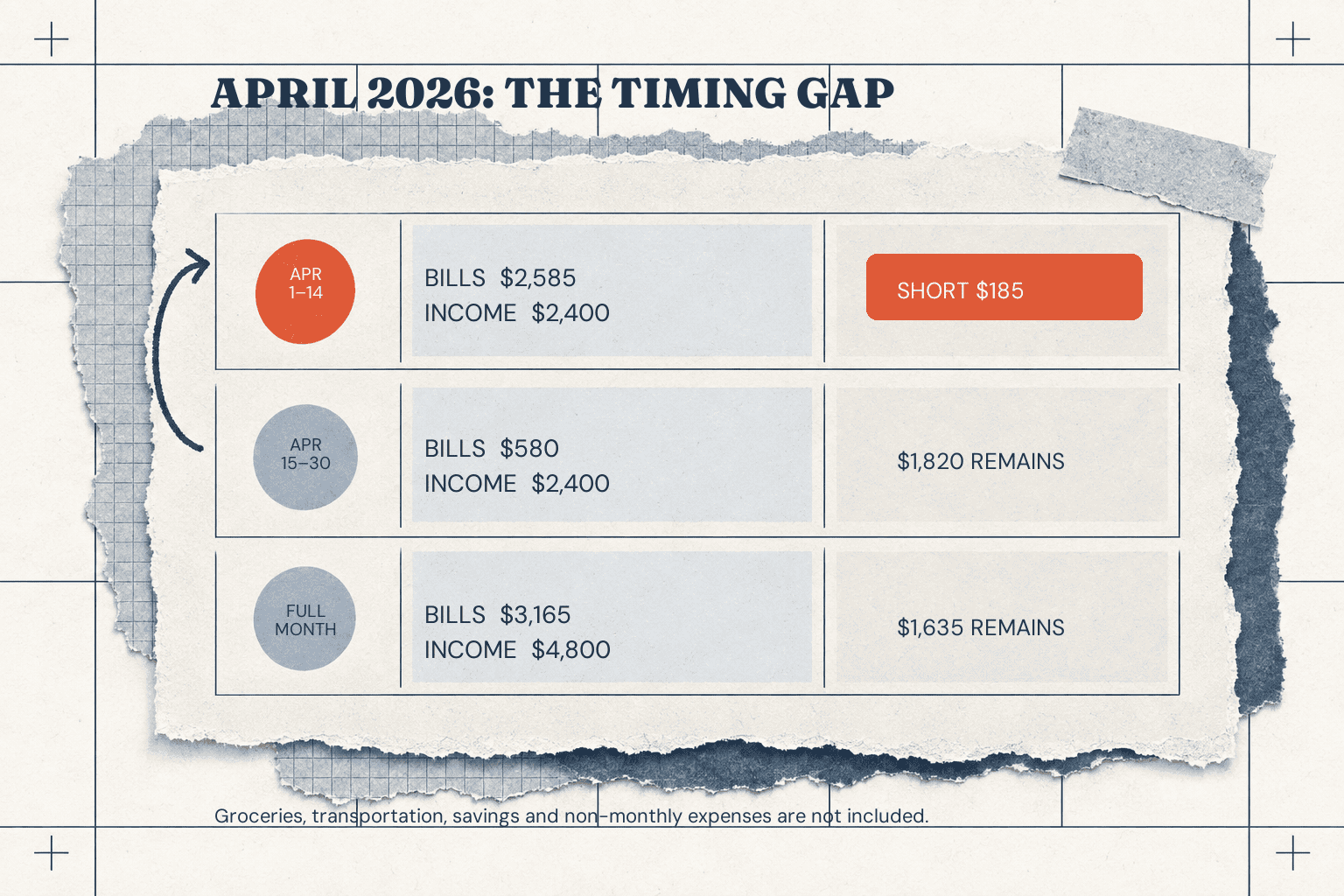
Before assigning prior-period money, the due-date view looks like this:
| Window | Bills due | Income arriving | Result before opening funds |
|---|---|---|---|
| Apr 1–14 | $2,585 | $2,400 | Short $185 |
| Apr 15–30 | $580 | $2,400 | $1,820 remaining after bills shown |
| Full month | $3,165 | $4,800 | $1,635 remaining after bills shown |
The $185 first-period shortage assumes no opening balance and no prior-period money has already been assigned. Once the household intentionally reserves $1,650 from the March 15 payday or another existing balance for rent, the April 1 deposit no longer has to do that job.
The $1,635 monthly remainder is not automatically extra money. This example has not assigned groceries, gasoline, household spending, savings or non-monthly expenses yet. Those dollars still need jobs.
The rent timing makes the calendar useful. Rent is due Wednesday, April 1. A household using a three-day planning buffer would schedule it around Sunday, March 29, while the CFPB’s two-day online mark would be Monday, March 30. Processing rules may change the exact date. Either way, waiting for the April 1 paycheck is too late for a plan that requires the money before then.
This is the difference between discovering a shortage and designing around it. The first creates a scramble. The second gives the bill a funding source before the month starts.
Build a ten-minute weekly review
A bill calendar only helps when it stays current. Pick one day each week and give it about ten minutes.
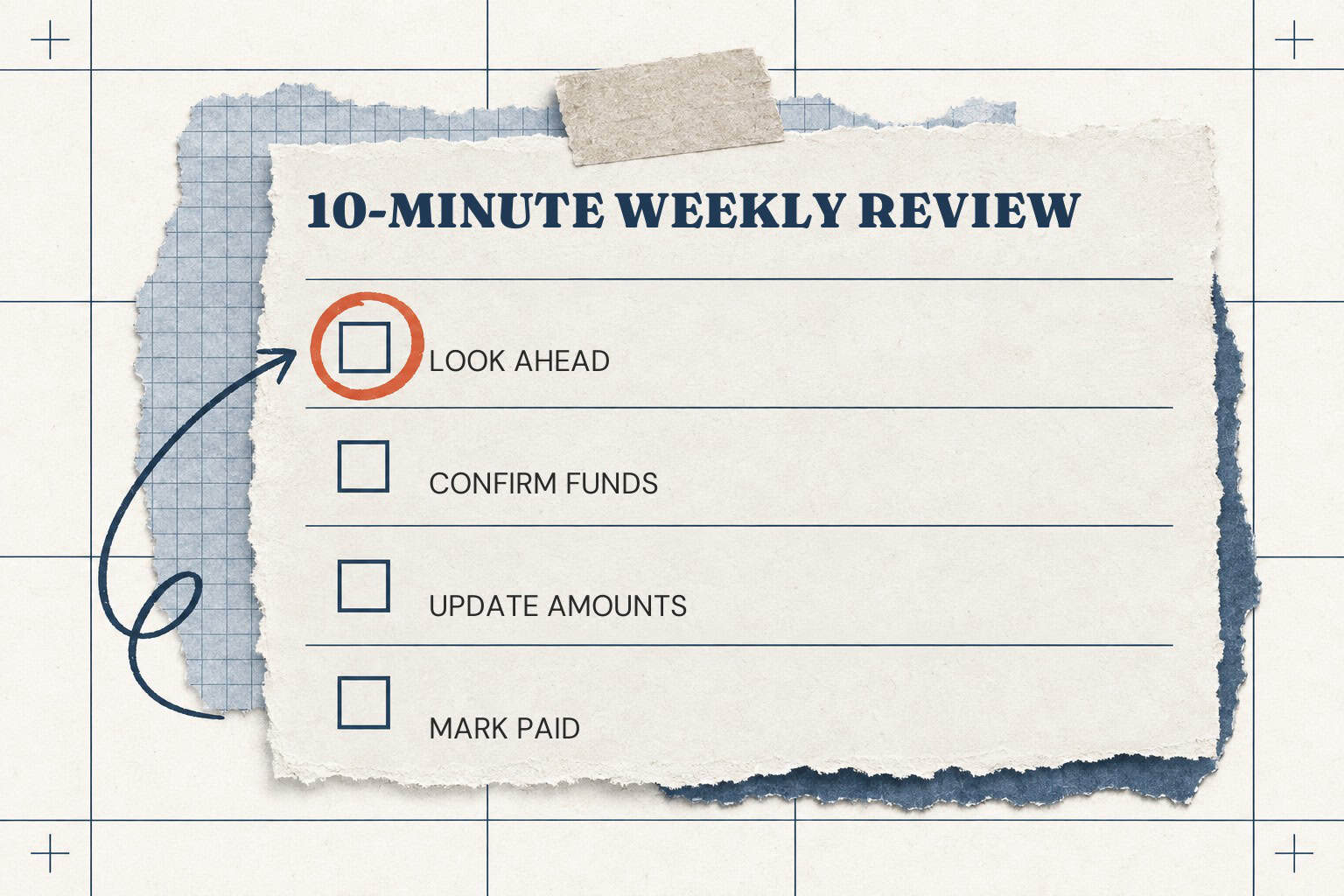
- Open the current month.
- Look for initiate-by dates in the next seven days.
- Confirm that each paying account will hold enough by its funding-needed date.
- Replace estimates with statement amounts.
- Mark completed payments without saving sensitive confirmation details.
- Look one week into the next month when an early bill needs prior-period money.
The CFPB likewise recommends putting the calendar somewhere you will check weekly and using the broader budget as a guide. (CFPB bill-calendar guide)
Keep the review small. You are not rebuilding the whole household plan every Sunday. You are checking what happens next and whether the assigned money is still available.
What to do when a bill keeps landing before income
When the same due date repeatedly lands before the money intended to cover it, the calendar has identified a planning decision. You have several options.
Fund it from the previous payday
Reserve the money on purpose and write that source beside the bill. In the fictional example, April rent belongs to prior-period money, not to the April 1 deposit.
Ask whether the due date can change
Some companies allow a due-date change and some do not. Ask when the change would begin, whether the transition bill will be larger, whether a fee applies and whether autopay must be updated separately. The CFPB provides a worksheet for comparing weekly inflows and outflows before requesting a different date. A preferred due date is not guaranteed. (CFPB due-date worksheet)
Change the payment method
Moving from mail to an online payment may reduce processing time. It will not solve a real income shortage, but it can remove avoidable delay. Confirm the biller’s processing policy before changing the initiate-by date.
Build a bills buffer
A small balance reserved for bills can reduce timing pressure. A larger version is getting a month ahead, where next month’s plan is funded before that month begins. YNAB teaches this as an optional progression, not as a requirement every household must reach on a fixed timetable. (YNAB month-ahead guide)
Change the expense or ask about hardship options
If the calendar exposes a structural shortage rather than a date mismatch, rescheduling alone will not fix it. Review the service, plan or payment arrangement. Contact the provider directly for account-specific options. Do not assume that a date change, buffer or different payment method will prevent every fee.
Complete one month today
You can build this version in Google Sheets without waiting for a special app or download:
- Create the bill and income tables.
- Enter one month of real due dates and dependable deposits.
- Add an initiate-by date and funding-needed date for every bill.
- Assign each bill to a payday or existing balance.
- Highlight any window where the assignment does not work.
- Choose one response: prior-period funding, a due-date request, a buffer or a change to the expense.
Do one month first. Once the dates and assignments work, duplicate the tab and update the next month’s amounts.
This bill calendar template helps you see the timing problem before it becomes a payment problem.
Start with the next payday and assign every bill it needs to cover.
Educational notice: This article provides general educational information, not individualized financial, tax or legal advice. Due dates, fees, processing times and hardship options vary by provider and account. Confirm the terms that apply to you.